




Cardano’s ecosystem health, tracked across DeFi value, network use, and positioning, has slipped into outright collapse, according to BeInCrypto’s read of the data. Yet on June 7, the largest ADA wallets quietly started buying.
That contradiction is the story. Whales accumulating into a measured collapse is rarely a bottom call, and the derivatives data points to a colder motive than recovery.
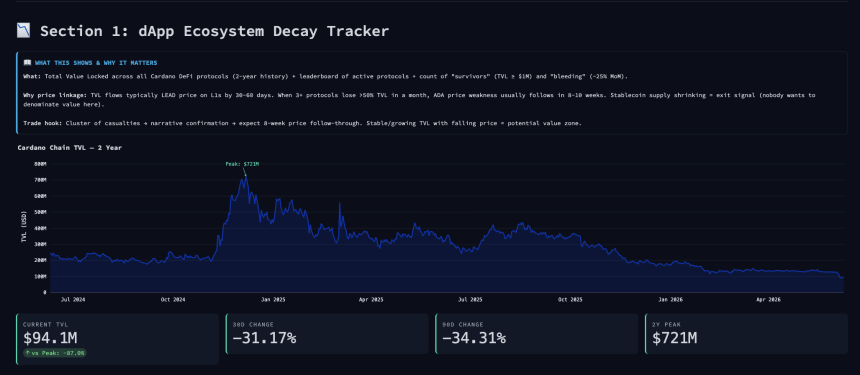
The Cardano Decay Tracker Hit Collapse
Start with the signal in the headline. The ecosystem read on Cardano, which weighs DeFi value against network activity, has reached its worst level.
Want more token insights like this? Sign up for Editor Harsh Notariya’s Daily Crypto Newsletter here.
The core input is total value locked, the dollar sum staked across a chain’s apps. Cardano’s TVL sits near $94 million, down about 31% on the month and roughly 87% from its $721 million peak.
By this framing, a chain shedding that much locked value with no offsetting growth is in collapse, not correction. The label is a measured verdict, not a mood.
This was already an ecosystem in trouble. Analytics platform TapTools shut down, and its founder, Charles Hoskinson, warned of a coming wave of failures.

Into that backdrop, the whales did the one thing the data says they should not. They started buying.
The Whales Bought on the Worst Day
Here is the twist. Two whale cohorts, meaning wallets large enough to move the Cardano price when they trade, began adding ADA on June 7.
Wallets holding 1 million to 10 million ADA lifted their share of supply from 15.24% to 15.28%. The largest tier, 100 million to 1 billion ADA, grew its stash from 5.83% to 6.16%.

The date matters. June 7-8 brought no good news. Investigator Thomas Braziel escalated a probe into Cardano’s founder that day, naming the original 2016 foundation board and pressing on roughly 1,090 Bitcoin missing from the early foundation.
The Cardano price was already near $0.16, a five-year low. Accumulating into a deepening scandal and a collapsing ecosystem is not how conviction buying usually looks. So the buying is real, but the reason is not fundamental. The derivatives data reveal what it likely is.
Big Traders Short, Retail Long
The motive sharpens on the futures side. The largest accounts and the crowd sit on opposite sides of the trade.
The top-trader long-short ratio, which tracks how accounts in the top 20% by margin are positioned, is 1.53. The all-accounts ratio sits at 2.09, a divergence of 0.57.

Retail is far more aggressively long than the biggest traders, the widest gap in weeks. When informed accounts lean against the crowd this hard, the crowd usually ends up wrong.
Note: Both cohorts are still net long, but the top traders are short relative to retail, holding far fewer longs than the crowd. That relative gap is the widest in weeks, and informed money leaning back while retail piles in is the classic shape of a top, not a floor.
Leverage has also drained. Open interest, the total value of live futures contracts, fell about 39% over 30 days to $70.6 million, with funding near neutral. That thins the fuel, so any squeeze would be smaller than the lopsided positioning alone suggests.

Still, the skew is what matters here. Big traders short against a heavily long crowd is the setup for a squeeze, and that skew is the missing piece of the whale puzzle.
The Dark Theory: Engineered Exit Liquidity
Now the pieces lock. The accumulation reads less like a bottom and more like a setup for exit liquidity.
Retail spot selling has cooled. The net outflows that ran through June 7 eased by June 8, hinting retail is ready to buy again rather than dump.

The likely sequence follows. Whales accumulate spot, retail buying lifts the Cardano price, and that push forces heavy shorts to cover, triggering a short squeeze where forced buying accelerates the move higher.
A sharp squeeze would hand the accumulating Cardano whales the liquidity to sell into. Retail supplies the exit, the shorts supply the fuel, and the whales step out near the top.
It is a cynical read, not a certainty. But with the decay tracker at collapse and no catalyst in sight, exit liquidity explains the buying better than recovery does.
What Would Break this Cardano Theory
Because the thesis is dark, the counter-signals matter. A few developments would flip it.
Whale accumulation sustained over weeks rather than days would point to real conviction. A genuine rebound in TVL or a credible answer to the governance probe would give the buyer a fundamental floor.
None of that exists yet. The most grounded reading is that the whales are not calling a Cardano bottom. They are building a position to sell into whoever buys the bounce.
The decay tracker was already flashing collapse. The whales did not ignore it. They may be planning to profit from everyone who does.
The post Cardano Whales are Quietly Buying a Collapsing Chain, and the Motive is Dark appeared first on BeInCrypto.